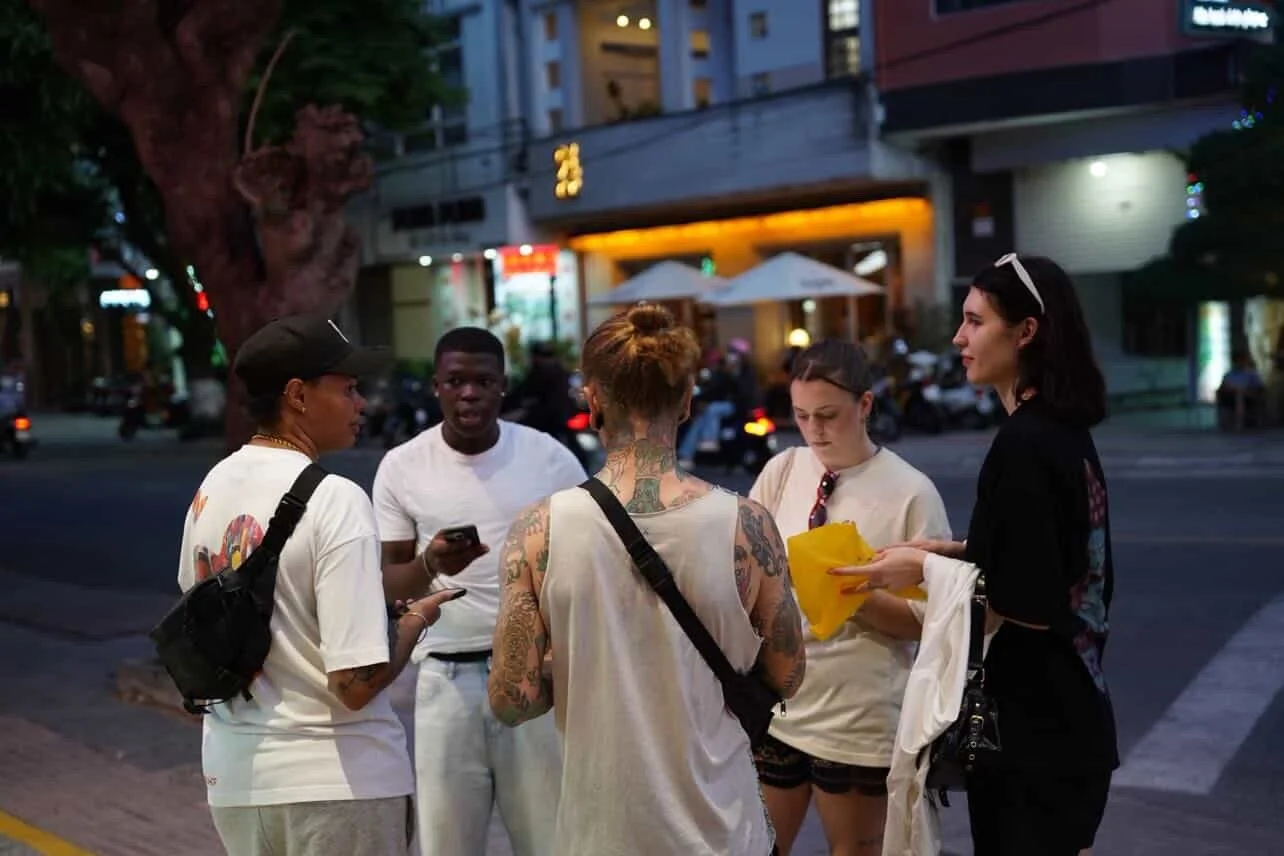
Abigail (left) briefing models during an “Akara” photo shoot in Da Nang, VN
The Owner
Abigail Slagveer, a 30-year-old entrepreneur born and raised in Rotterdam, embodies the cultural duality of her heritage as the daughter of a Dutch father and a Surinamese mother. Her upbringing was defined by annual travels between the Netherlands and Suriname, a recurring journey that instilled in her a persistent tension between two distinct worlds: the structured, opportunity-rich environment of the Netherlands and the warm, family-centered energy of Suriname.
The transition from a career in logistics to the founding of Akara was born out of both necessity and a profound search for purpose following a COVID-19-induced career shift. While Abigail established stability as a property appraiser in Rotterdam, Akara emerged not from a formal business plan, but from a visceral drive to bridge cultural divides and help others "live in their purpose," a philosophy now immortalized in the brand's slogan, "Be a Masterpiece".
A pivotal moment occurred during her work with the Bridge to Knowledge project; while she found fulfillment in relocating Surinamese engineers to the Netherlands, she faced an internal crisis over contributing to the "brain drain" of her heritage. This conflict, followed by a timely church sermon and a validating encounter with a street painter in Chiang Mai, Thailand, in late 2023, crystallized her mission to build a platform that empowers global talent within their own communities.
The Business Model
Akara operates as a mission-driven enterprise that leverages a scarcity-based retail model to facilitate global cultural exchange. The brand focuses on high-margin, limited-run releases that prioritize the artist’s narrative over traditional mass-market apparel volume.
Product & Service Strategy: Akara specializes in limited-edition T-shirts 90 EUR that serve as narrative vehicles for original artwork sourced from local artists globally. This core offering is supported by a "Basics" line 40 EUR to provide a steady revenue floor alongside high-concept releases.
Target Persona: The brand caters to "conscious consumers," individuals who prioritize cultural storytelling, exclusivity, and authentic art over the disposable nature of fast fashion.
Demand & Scarcity Model: Operations follow a strict drop-based pattern where exclusivity is permanent. Due to the limited nature of the commissioned art, once a design sells out, it is never restocked, driving a "buy-it-now" consumer psychology.
Market Dynamics: Customer engagement is currently a mix of one-time and repeat buyers. A key strategic focus is "cross-pollination," where Abigail actively encourages buyers to move beyond designs from their own heritage to engage with and support unfamiliar cultures.
The Econmics
The financial structure of Akara is defined by a release based model rather than daily sales volume, with revenue driven by the contrast between 90 EUR design T-shirts and 40 EUR basics. While specific revenue and profit margins are withheld at the founder's request, the business faces significant upfront costs including inventory, branding, and a recent partnership buyout. Major operational expenses include artist design fees, manufacturing in China, multiple sampling rounds, and international logistics, all while navigating a high Dutch tax bracket of 37.5% to 52%. Consequently, the business is currently in a low-stability, early stage, focused on absorbing these initial investments as it works toward its first break-even point.
Operations
Since the dissolution of her partnership in early 2025, Abigail has operated as a solo practitioner, managing every facet of the business from on-the-ground artist sourcing and design negotiation to manufacturing coordination and order fulfillment. Her workflow relies on a lean tech stack, utilizing Excel and her website to track inventory, but remains heavily dependent on her personal travel schedule and the availability of artists willing to be documented. While she maintains a strong relationship with a T-shirt manufacturer in China, expanding the product line presents a logistical hurdle, as different garment types require sourcing entirely new manufacturing partners. These operational dependencies are further strained by critical bottlenecks: the language barriers and distance that complicate artist communication once she leaves a country, and her self-described primary challenge, the consistent creation of social media content necessary to drive brand visibility.
Constraints
The primary obstacle facing the business is the friction between Abigail’s technical strengths in research and sourcing and the demanding requirements of digital marketing. While she excels at curate-led design, the consistent creation of social media content filming, editing, and maintaining a narrative, remains a significant bottleneck that limits the product's reach. This internal challenge is compounded by external risk factors, such as artist reluctance to participate in public storytelling and the potential for communication dropouts once Abigail leaves a sourcing location.
Furthermore, the venture navigates a restrictive external environment in the Netherlands, characterized by high tax rates that limit reinvestment capital from her primary career, a less robust entrepreneurship culture than that of the U.S., and complex regulatory hurdles for hiring support staff. Ultimately, the business reaches a critical break point if sales stall for an extended period, as capital remains tied up in physical inventory while unfulfilled commitments to participating artists begin to accumulate.
Owner’s Mindset
Abigail is playing a long game, prioritizing long-term growth with a five-year horizon that aims to evolve Akara from a clothing brand into a comprehensive cultural platform. Her vision extends beyond apparel to a diversified range of limited-run products, each serving as a narrative vehicle for makers in underrepresented regions to reach conscious global consumers. This ambition is backed by a moderate-to-high risk tolerance; she is currently self-funded and working a parallel day job, demonstrating a willingness to operate at a loss during this foundational stage. As she shifts from a traditional Dutch "save first" mentality toward a more aggressive investment-led approach, her roadmap moves from an immediate goal of breaking even to a medium-term focus on scaling her social presence and team. Ultimately, her goal is to leverage this platform to fundamentally shift Western perspectives on value and talent.
Cultural Context
Akara functions at the intersection of fashion, cultural documentation, and ethical sourcing, serving as a direct challenge to the assumption that talent and opportunity flow exclusively from the developed to the developing world. This social role is deeply rooted in Abigail’s upbringing in Rotterdam, one of Europe’s most multicultural cities, where she was shaped by Turkish, Moroccan, Cape Verdean, and Surinamese communities. Her perspective is a synthesis of this diverse environment, utilizing her Surinamese heritage as an emotional counterweight to the structured efficiency of Dutch life. This cultural foundation is reinforced by a supportive personal network, with her mother actively championing the brand’s digital presence and friends providing a critical feedback loop for content before it is published.